
Excellencies, Lok Chumteav, Members of the Senate, the National Assembly, and the Royal Government; Ambassadors and Diplomatic Representatives of various countries in Cambodia; Excellencies of the Presidium, National and International Distinguished Guests, Civil Servants, Teachers, and Beloved Students!
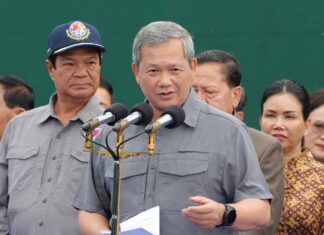
Today, I am truly delighted to join as the chairperson to open this meaningful and historic “Exhibition Ceremony for the 100th Anniversary of the National Archives of Cambodia” (1926–2026). As Cambodia prepares to host the Francophonie Summit 2026 next week, this centenary exhibition of the National Archives is not only a commemoration, but also an important national statement platform reflecting the strong commitment of the Royal Government of Cambodia in preserving, safeguarding, and modernizing documentary heritage and national memory.
The organization of this exhibition—turning the historic premises of the National Archives and the National Library into a “Public Heritage Zone” for a full month—testifies to our high sense of responsibility in preserving documentary heritage, archives, and archival institutions as national assets and chains of national memory to prevent them from loss or damage. As the Khmer proverb highlights, “A tree stands firm because of its roots.” These documents and archives are the “roots” or “taproot” of national identity and knowledge, requiring us to strive for both physical preservation and digitalization so that future generations have a solid foundation for study and research.
As the Senior Deputy Prime Minister mentioned in his welcoming speech, the National Archives was officially launched in 1926 with the primary objective of managing and preserving important national documents using modern scientific methods. At that time, however, the National Archives was managed jointly with the National Library.
The establishment of this institution stemmed from the concerns of Albert Sarraut, Governor-General of French Indochina, who worried about the quality of increasingly accumulating administrative documents. This led him to propose four essential measures required to preserve these documents: 1- Collecting documents and destroying those of no value, 2- Retaining valuable documents, 3- Establishing a special building to preserve documents under good environmental conditions, and 4- Organizing a document classification system to integrate new materials into the National Archives. Stemming from this concern, Cambodia began adopting this Western-style document management and conservation system.
Although Cambodia recently adopted a Western-style system for document management and preservation, it has a long-standing tradition of recording and keeping its own documents dating back to pre-Angkorian times, a precious heritage passed down by our ancestors. Evidence from the pre-Angkorian and Angkorian periods shows that ancient Khmers recorded information on various materials, such as palm-leaf manuscripts, folding books (krang) made of thick paper, animal skins, stone, and metal.
Although many ancient document types have been lost or degraded due to natural and wartime factors, Cambodia still retains stone writing heritage known as “stone letters” or “inscriptions” dating back to at least the 5th century or even earlier, possessing the largest number of inscriptions in Southeast Asia. These compiled and preserved documents include historical and official records, legal and administrative files, photographs, maps, land titles, economic and inventory records, and religious and legal treatises written in Old Khmer, Sanskrit, and Pali, which serve as essential evidence for constructing ancient Khmer history.
Over the 100 years since its establishment, the institution has weathered numerous historic storms and trials, particularly during the dark era of the Khmer Rouge genocidal regime, when the National Archives was abandoned, used as an animal shelter, and many documents were destroyed. However, driven by patriotism and unyielding resilience, our nation’s “keepers of memory”—newly trained officials in the post-war era—gathered and reorganized documents from the ashes starting in 1979 to build the robust institution we see today. Today, the National Archives has become a national heritage site closely tied to “national identity,” “sovereignty,” and “territorial integrity.”
Because the National Archives houses historical documents, maps, treaties, and official records with clear provenance, it serves as a valuable source of evidence to support studies, determine official stances, and protect national interests. A clear example is the case of Preah Vihear Temple, which demonstrated the vital connection between heritage, history, international law, and national sovereignty. Therefore, maintaining archival documents with a proper management system to guarantee authenticity and develop research capacity is a task extending far beyond the cultural sector, contributing to the long-term defense of national interests.
Organizing this centenary exhibition under the theme “A Century of Memory Towards Enhancing National Identity” also clearly bears witness to the historic ties and long-standing close cooperation between Cambodia and France. In the spirit of “researching the roots to know their value,” we cannot overlook the indispensable role and figures of France, both in the past and present. At a time when Cambodia has faced border dispute challenges with a neighboring country (Thailand), historical archival documents, official treaties, and maps compiled and preserved by the French side serve as legal armor and the most valuable historical evidence to assert and protect the territorial integrity, sovereignty, and legitimate borders of the Kingdom of Cambodia.
Cooperation with France in repatriating and digitizing archives is not only a historical connection, but a genuine bridge protecting national sovereignty. Furthermore, this exhibition is a vital preparation for Cambodia as the host of the “Francophonie Summit 2026,” offering a golden opportunity for the Kingdom to showcase its national prestige, supreme culture, cultural diplomacy, and strong commitment to promoting peace and multilateralism on the international stage.
As the world steps rapidly into the Fourth Industrial Revolution and the socio-digital economy amidst complex shifts in geopolitics and geo-economics, the 7th-legislature Royal Government has introduced the “Pentagonal Strategy – Phase I,” which aims at two primary and long-term goals derived from its strategies and policies: building and strengthening Cambodia’s state and nation.
In the state-building process, we are preparing and implementing reforms and strengthening legal and regulatory frameworks to govern the country, while reforming and enhancing institutional capacity and operational efficiency so that the state can fulfill its missions and functions effectively—such as defending sovereignty and territorial integrity, maintaining political stability, security, and social order, socio-economic development, delivering public services, and developing human capital.
Concurrently, we must strengthen our soft power in the nation-building process, promoting national identity, patriotism, national consciousness, and national unity by building awareness, recognition, and shared ownership of our history, culture, and core national values. These are two major tasks that must be pursued continuously, tirelessly, wisely, and resolutely to strengthen Cambodia so that it can stand on its own, develop, remain strong, defend itself, and prosper independently.
From this perspective, I have issued guidelines to modernize the National Archives, National Library, National Museum, and preserve major national heritage sites in Cambodia. Recently, I also established the National Committee for Cambodian Culture, History, and Civilization, chaired by Senior Deputy Minister Vongsey Vissoth, to orient, coordinate, and promote the enhancement of this soft power.
[Impromptu-1]
(1) The National Library and National Archives have different duties, but share preservation and dissemination roles
The preservation and utilization of historical documents across all sectors are interconnected. We observe that both institutions—the National Library and the National Archives—have distinct roles, differences, and distinct goals for document retention. For example, the National Archives mostly houses state documents, original records, and various maps, whereas the National Library preserves research materials and books. However, they share commonalities: both act as preservers and disseminators.
(2) Today’s documents will become history in 50 to 100 years
First is document preservation. All forms of documents are used in research. Earlier, stepping into the National Archives, we saw old maps dating back to early times, kept alongside newspapers and even a letter written by our former King to France requesting protection, as well as a letter dispatching the Cambodian Red-Legged troops to fight in World War I. These documents are extremely valuable and must be preserved. Naturally, war caused some destruction of archival documents. Earlier, I asked the aunt who looks after the National Library. She said that after Pol Pot, 20,000 copies remained, but prior to that, we had about 100,000 documents. It is regrettable that so much was lost. Nevertheless, it is essential to preserve what we have and add to it, because today’s documents will become history in 50 to 100 years. The National Archives stores official gazettes, past and present documents, maps, and treaties as essential records. The National Library similarly maintains certain historical documents.
(3) The National Library and National Archives serve as documentation resource bases for researchers
Second is dissemination. Both institutions form the foundational collection of resources for researchers. The National Library is more open because most materials are research texts and books. The National Archives holds confidential state documents and files with restricted use and distribution. However, research is still possible, and some areas can be opened up. These similarities require careful thought. We must modernize by scanning and digitizing to preserve original records. Documents printed today will be half a century old 50 years from now. We think they are new today, but in 50 years they will degrade. Documents we consider worthless today might be picked up and used 10 or 20 years later. Many people look for their recorded documents only to find them gone.
(4) Original and historical documents kept in the National Library and Archives are more valuable than a lump of gold
The National Library and Archives must be strengthened for the nation. As Excellency Vongsey Vissoth noted, this has been our goal since 1979. I have seen the principles of organizing this archival institution since the end of the Pol Pot regime—collecting people and abandoned documents from the Pol Pot and war eras, restoring and storing them, and training successors. Earlier, I saw map restoration in progress. Several aunts in the restoration building have worked there for 30 years. Although they did not graduate from university in archival studies, they learned from one another and maintained the dedication to keep things well preserved until today. Thirty to forty years of work is now being improved further. This is valuable. The National Bank keeps gold; the National Archives and National Library keep gold that is more valuable than a lump of gold—namely, original and historical documents. As stated in the speech, if a nation has no taproot, where does it come from, and how is its taproot proven—through word of mouth?
(5) Preserving original, unalterable documents to protect identity
In the technological age, anyone can write anything. However, original documents must serve as the baseline. Researchers must protect these documents. For instance, if we want to search for someone’s information, we look up their name and Wikipedia pops up. But anyone can edit Wikipedia. Original documents cannot be altered and must be preserved. Without original documents, we cannot protect our identity because modern copies look identical to originals, especially regarding historical events and figures. If a certain item represents our culture and history states one thing—for example, that a place previously belonged to a certain ethnic group—and those documents are lost, someone else could write new accounts following the saying “history is written by the victors.” Burning previous royal records and writing new history makes future generations believe that place was always theirs. If we lose physical evidence, we lose our identity. We know how far the Khmer empire reached based on prior evidence. Inscriptions exist, but we also rely on stored documents.
(6) Collecting original documents for Khmers to continue research and write further
Original documents are not only those we wrote ourselves, but include research by foreign scholars such as Zhou Daguan who arrived during the Angkorian period, the French, and others. We collect and preserve them so Khmers can continue to protect them, research, and write further. Once, when studying abroad, I looked for books on Khmer history. Very few were written by Khmers; most were written by the French and Americans. We have inscriptions on palm-leaf manuscripts. Yesterday, someone sent research materials written additionally by the Writers’ Association. Such research must rely primarily on original documents. Otherwise, relying on secondary sources step by step distorts things. When people want to write about Khmer history without looking further than Google, that is dangerous. Therefore, one must seek primary documents—the sole original source of study and research. What was the name of the author who wrote a book I met in America? David Chandler. He also wrote about and researched Cambodia. When I was doing research, I met him once. But his work is also secondary research. We must have properly preserved primary documents.
(7) Hard to preserve during war; must be kept in times of peace
Today’s official gazette is an original document that will serve ongoing research into various affairs. We are currently negotiating UNCLOS regarding the sea, which will become a historical record. All documents will be recorded as history. Maritime negotiations from 2026 to 2126 or a century from now are historical matters concerning maritime boundary demarcation or the steps taken to define water boundaries. This is no different from the documents and maps attached 100 years ago between 1905 and 1907. They must be filed away. That we experienced war and faced hardships (we could not do that); now that we (are at peace and) have facilities, we must preserve them. While caring for past historical documents, do not forget current documents that will become future history. Therefore, I support the discussions with (the Deputy Prime Minster, Minister in charge of the Council of Ministers), HE Vongsey Vissoth, as I see the ECCC archives are well maintained and have become a research center. It is part of our history. Please look at this model and strive to study it similarly.
(8) Various governance formulas exist worldwide for National Libraries and National Archives
Strengthening governance management: ministries and institutions worldwide use various formulas to govern national libraries and archives due to their unique, shared, and distinct characteristics. However, in the future, they will become increasingly similar, especially with digitization. Some documents in our archives can also be shared for research purposes. During preparation, they must be digitized first, regardless of whether they are shared later. Documents must be converted or original texts preserved, entered into digital systems, and backed up. Earlier, a teacher at the National Library asked for a cloud system. Is Excellency Chea Vandeth here? From the Ministry of Posts and Telecommunications. The National Library has scanned documents stored on disks. Such storage can degrade. There must be backups. Please help arrange a cloud system stored in our national data center to preserve these documents with strong cybersecurity. Buildings can be rebuilt if something happens, but documents cannot.
(9) A single decaying piece of paper from 200 years ago has more dissemination value for the nation than a lump of gold
If original documents cannot be found, copies or digitized versions must be created to a certain standard for preservation. Earlier, I saw good security inside this building. Excellency Vongsey Vissoth stated that document security will be addressed immediately. As I said, a lump of gold is visible and can be made into a necklace, but a single piece of paper surviving from 200 years ago, even if decaying, holds more value and dissemination worth for our nation than a lump of gold. It must be protected. Second, regarding management: we currently manage these two institutions separately. The National Library is under the Ministry of Culture and Fine Arts, and the National Archives is under the Office of the Council of Ministers. There is nothing wrong with this; it is the structure we arranged previously due to differing roles, duties, and laws. In the future, they will grow closer, especially regarding information sharing for maintenance combined with certain research activities.
(10) Management formulas for libraries and archives in various countries
Many countries adjust their governance formulas differently. In the United States, the Library of Congress is under Congress, while the National Archives is under the executive government as an independent agency under no single ministry. Canada previously had two separate entities and merged them into a single institution called Library and Archives Canada under unified management. The UAE, Ethiopia, and Egypt similarly created combined entities, though management placement varies—some under culture ministries, others independent under heads of government, and some under interior ministries. They differ, but they are unified under a single institutional umbrella.
Other countries, like Singapore and New Zealand, use different formulas. They do not merge them into a single entity, but place them under an administrative umbrella while keeping the two units independent with distinct roles. In Singapore, the National Library Board was created to manage them. In New Zealand, they are placed under the Department of Internal Affairs under a single umbrella, so planning and sharing do not require approval from two separate ministries; planning, maintenance, digitalization, and research classification are handled by one institution. In Singapore, it is not just those two; other libraries are managed too. Because Singapore is small, all libraries—national or otherwise—are interconnected.
(11) Future sub-national archives linked through information networks
Which formula should Cambodia adopt? Streamlining into a single institution or maintaining two institutions under one umbrella? We are considering keeping them separate. We now have the ECCC archives and the National Archives. In the future, there might be sub-national archives at some level, as this is a specialized task requiring interconnected information. We must avoid a situation where a student in Phnom Penh has to drive to Battambang just to do research. Naturally, confidentiality must be maintained. Some places connect via the internet, while others use an intranet. An intranet stays within the fence and does not connect to the internet. Sitting at the National Library, one can use computers connected to the National Archives to access public documents without having to physically move there. Yet, outsiders cannot hack it because it is restricted to the local area network (LAN). That means it cannot be hacked.
(12) Future data sharing between the National Library, National Archives, and ECCC Archives
Security considerations are separate, but management is what we are discussing now. To this end, the Royal Government has established an inter-ministerial commission tasked with integrating and modernizing the National Archives and National Library, led by Excellency Vongsey Vissoth. Earlier, the cultural promotion committee […] was asked to study this with representatives from the Ministry of Culture to discuss management formulas for modernization. First, resources—meaning documents, even if housed in two institutions. Resource sharing and networking mean that in the future, we won’t need to build three or four separate buildings for the National Library, National Archives, and ECCC archives; they can be centralized to share data directly. If managing two or three separate institutions is difficult, a single institution can manage them under one umbrella, while the National Archives and ECCC archives remain distinct units coordinated under a common umbrella.
(13) Not dissolving the National Library into the National Archives, but maintaining single administrative oversight
Earlier, I briefly discussed this with Excellency Vongsey Vissoth. I suggested we should not follow the Canadian model of dissolving the National Library into the National Archives as a single entity. We should keep them separate, but provide unified administrative oversight and support for maintenance, human resource training, and modernization—especially regarding document care. Valuable documents not only preserve history, but pass on knowledge so younger generations of Khmers know their history and identity. That is why their value exceeds gold. Protecting our taproot is worth more than gold. Therefore, they need care, sharing, and accessibility to increase the number of students coming to study and research. Today, we see students visiting. Do not rely too much on Google, and do not rely solely on AI for research.
(14) Encouraging Khmers to research and write theses based on factual documents for sharing
Earlier, I took a quick look; there are rare documents hundreds of years old here, some decaying to the point where negligence would lose them. This consideration is vital. The working group is studying options, and integration is not yet finalized. I ask Excellency Vongsey Vissoth to lead an evaluation on how we should integrate them. The formula we discussed—like New Zealand or Singapore—suggests that at this stage, we should not merge them into a single institution like Canada. They remain two distinct entities under unified management because their duties, expertise, and operational rules differ. Researchers recognize the value of documents […] Khmers learn their own history written by foreigners. Therefore, we must encourage Khmers to research, produce shared works, and write theses based on factual, high-quality, and important documents. If certain documents are written unclearly, misunderstandings arise. A wrong answer corrected by a teacher is one thing, but historical errors are difficult because different countries’ histories sometimes contradict each other, with each claiming ownership.
(15) History and roots are vital, especially in the modern era of easy document compilation
If we use references—for instance, a student visits a library, picks up a book written by a foreigner who did not examine all sources—and then subsequent researchers build upon that, it becomes dangerous. History and roots are important. Some people say they are not, but I think it is essential. Even if we evolve to reach the realm of Indra, we must return to some country. Even if we travel to the moon, we must return and answer which country we landed from. When I lived in America, people mingled. They asked where you came from; even if you are an American citizen, they ask if you came from the Philippines, Cambodia, or Colombia. Roots are crucial, especially in the modern era when documents are increasingly accessible. I encourage enhancing their preservation, curation, and utilization.
(16) Principles of proper, long-term archival preservation and accessible research
Yesterday, launching a high school in Tang Kork district, Kampong Thom, I encouraged reading from a young age and building reading habits. University students must read too. We have theses to write, but do not forget research methodology. We need information to write theses, but the source of your research is crucial. Do not forget original books and documents in libraries or archives that we can access. Especially if writing about Cambodia’s history or political history, you must consult our documents; otherwise, writings become distorted. Khmers who do not know their own history might unwittingly write to help others. Archival documents, palm-leaf manuscripts, museums, and other repositories must be promoted for use. Preservation must be coupled with promotion and appropriate conditions […] The Royal Government’s principle is to preserve them well and long-term while enabling accessibility for research. Excellency Vongsey Vissoth has already requested that more students come to research here.
(17) Encouraging book reading in libraries and seeking primary sources for research
If a student does not enter a library, they are not truly a student—to put it simply. How many students enter the library to read research books instead of relying entirely on Google? Scholars must read books, even digital ones, but reading physical books in libraries is encouraged, especially for research requiring primary sources. When I wrote my thesis, I sought out primary sources. Secondary sources are abundant, but primary sources are the diamonds. Use primary sources from our National Archives, National Archives, and ECCC archives if relevant. Textbooks are secondary sources researched by others and used for further study; they are secondary steps. Students, please do not forget to read books and do not rely too much on phones and AI. Some foreign schools like Harvard no longer allow digital devices inside because students stop learning and just record teachers while playing on TikTok. How many use AI for research? Who uses it, raise your hands?
(18) Using Artificial Intelligence as an assistant, not a replacement
So we know digital tools; nobody forbids them, but do not rely on them as the sole research source. How many had AI write for them? One person raised their hand. A brave soul in the back. Raise your hand again: AI wrote your assignment? Two people? How much did AI write? Did you get full marks? […] Use AI as an assistant, not a replacement. Well said. Those who raised their hands versus those who spoke differ, protecting each other. An assistant, not a replacement. Okay. An assistant, not a replacement—let’s be clear. Once it replaces us, we stop learning and depend on it entirely because AI is very smart. I use it too, but sources must be cited. When asking AI, ask assistants to verify with ministries and institutions. Young people can write, but the Prime Minister speaking on a microphone cannot afford errors. Incorrect data is even less acceptable. Nevertheless, AI helps speed up certain thinking tasks. Some topics lack data, which is easy; others require intellectual synthesis. Still, as we develop digitalization and AI at the National Archives and National Library, we must use them while transforming raw materials and books to allow students access—even if copies, since originals are singular and can only be viewed as copies on paper.
[Back to the prepared text]
First: The Office of the Council of Ministers must prepare a strategic plan on modernizing the National Archives as soon as possible and make necessary amendments to the Archives Law to align with the evolving situation of Cambodian society and the world today.
Second: The Office of the Council of Ministers must cooperate with relevant institutions to promote the improvement and construction of archival infrastructure by improving the environment and order both inside and around the site to make it worthy of national pride, identity, centers, and national memory. Existing buildings must be properly upgraded to include offices and document storage rooms conforming to technical standards, while examining the feasibility of expanding buildings step-by-step as national institutions appropriate to the surrounding environment.
[Impromptu – 2]
(19) Upgrading buildings, offices, and archive rooms to be modern inside while exterior styles match heritage buildings
Regarding upgrading existing buildings, including offices and archives to appropriately serve as national archives, I agree. Earlier, we saw our space is tight. One hundred years ago differed from today; population and usage have grown. A century ago under French rule, few people could access archives. Today, students and researchers can enter. I see the location here is large enough to expand buildings. Although part of it currently houses a tent and a coffee shop, we will examine solutions for the future. When designing interior spaces, even if there is a coffee shop, it can connect to a building while keeping the exterior traditional and matching the heritage structures. I want this place to be an attractive spot—not just for researchers, but as a living museum of national identity storing documents. I see tourists visiting. Please keep the original floor tiles inside; they are 100 years old, so do not rip them up and replace them with Italian tiles. Wherever repairs are needed due to breakage, match the original form. I see similar reproductions can be made to match originals.
(20) Reviewing the Archives Law to determine which documents can be declassified and placed on the Intranet or other systems
This building is like a 5-star hotel inside, preserving original tiles while adding internet, air conditioning, and other modern features internally. I ask Excellency Vongsey Vissoth to organize this as a package. Researching here might be difficult now, but soon we will connect via internet and intranet. Front buildings and local areas can connect too. Such organization is modernization—modernizing study spaces because bringing in more researchers requires considering safety and security systems. We have an Archives Law concerning classified documents and management. Review the law and amend it if necessary to determine which documents can be declassified and placed on the Intranet or other systems. Sometimes external access isn’t needed; visitors can come in. General important documents can be found online, while sensitive documents that cannot be copied can still be viewed securely via the Intranet on local computers without copy permissions. We must consider this.
(21) Agreeing on expanding buildings/sites based on future document growth
Certain documents must never be read because they are state secrets; conditions must apply. But archival documents that can be shared should be accessible. Some parts allow copying, others do not, categorized accordingly. We must modernize to handle storage and usage rules rather than inviting students to research and telling them nothing can be viewed except to buy coffee at an Amazon or library/archive cafe with comfortable reading spaces inside. I agree with expanding the location because it looks too small to store incoming documents. As I said, today’s documents become tomorrow’s history. Annual official gazettes, published books, and research texts must enter the library, increasing the catalog. However, exterior architectural development must harmonize with older architecture because this building and the Ministry of Economy and Finance building are nearly 100 years old—approaching their centenary in 2028.
(22) Preserving the 100-year-old exterior appearance during site upgrades, adapting interiors to practical needs
They are all nearly 100 years old, so do not touch the exterior. For instance, security systems should have minimal exterior impact; modifications should be internal. Where window bars are needed against break-ins, place them inside while ensuring fire safety. Decide how much protection is needed and where to reorganize. Some use false glass facades where the outside looks pristine but entry is blocked by internal wood panels. From the outside, the 100-year-old structure remains intact, while interiors adapt to practical needs without exaggeration. Inside and out, it shouldn’t look overly modern. This hotel is 5-star, yet stepping inside gives a traditional feel with air conditioning and internet, but rooms lack carpets and drop ceilings; 100-year-old construction is preserved. This building seems older than the archives; earlier I saw construction histories—the hotel was finished before the archives, yet interiors are modern. I agree with considering expansion capacity.
[Back to the prepared text]
Third: Implement Digital Transformation to establish a national digital archive or electronic archive system to scan old records and major administrative documents as online data images with cybersecurity.
[Impromptu-3]
This must be protected. As I mentioned just now, I request His Excellency Vongsey Vissoth and His Excellency Chea Vandeth to assist, particularly with providing an urgent solution regarding Cloud storage. A moment ago, the teacher from the library requested it—the documents have already been scanned, but they need a Cloud system. Therefore, please help arrange this for preservation purposes.
[Back to the prepared text]
Fourth: Collaborate with the Ministry of Education, Youth and Sports, the Ministry of Culture and Fine Arts, and the Ministry of Post and Telecommunications to push for the strengthening and capacity-building of staff and technical experts. This should be done through training archival staff to possess knowledge in archival science, information technology, and digital data management, in cooperation with relevant institutions both locally and internationally. This includes recruiting capable students or officials who have been trained abroad to serve at the National Archives, as well as promoting the participation of youth and students in preservation efforts.
[Start of Commentary 4]
[Impromptu-4]
(23) Human resources working for 30 years out of dedication and learning through practical experience
This point on strengthening/increasing the capacity of staff and technical experts—training archival staff in archival science, IT, and digital data management—is crucial. We still lack resources. Our existing human resources of 30 years served through dedication and learned through practice. Only one aunt who recently retired obtained a degree from Poland, and now she is retiring too. Other aunts and uncles learned through short-term training provided by friendly partners. Archival and library management skills range from bachelor’s and master’s degrees to PhDs taught abroad. Library science covers information management, document management, and library science. Archives involve archival studies. We must strive for short-term and long-term training programs. We don’t need huge numbers; holding domestic classes might not even be feasible.
(24) If partners cannot provide opportunities, consider state scholarships for Library Science and Archive Studies
I spoke with Lok Chumteav Phoeurng Sackona about organizing training classes, but we could not launch them due to low student enrollment, making it hard to find instructors or run classes. I discussed with Excellency Vongsey Vissoth: if numbers are low, we should send candidates abroad for studies. Not all 20-30 people doing this work need bachelor’s degrees, but key managers and experts should. Set a goal: if not a PhD, at least a master’s in library science. The National Archives needs two or three people with such qualifications, while others needing technical skills can take short-term courses since updates are constantly needed in the AI era. Excellency Vongsey Vissoth, work with our partners; if not possible, consider state scholarships for overseas study, because waiting will be long—4 to 6 years of study—delays things. Some think a librarian just straightens books on shelves; that is not true. They need clear skills, maintenance knowledge, and conservation training.
(25) “Send them to study abroad; if no sponsor, the state sponsors directly…”
Even archival work requires evaluating document value and conducting evaluations. When old documents arrive and people search for them without knowing where they are, archivists can identify their origin and value. Training is vital. Thus, short-term training suits long-serving staff. I thank Excellency Vongsey Vissoth for keeping the retired aunt as an advisor and assistant due to her skills, health, and willingness to help train others. As I said, none of us live 150 years; eventually, youth must take over, so start training now. Earlier, I signed the 100-year golden manuscript, telling Brother Vissoth that in 100 years the two of us will come back to check. The aunts said by then they will have reincarnated as youths. Please treat training as an urgent task. Excellency Vongsey Vissoth may consider selecting one person from the archives and one from the library next year to pursue bachelor’s degrees abroad if needed. If no one sponsors them, the state will sponsor them directly. Start their studies; in four years, we will have personnel.
(26) Ministry of Culture gathering palm-leaf inscription communities into the 1.5 million skills program
Get started, but find people who want to learn. This skill requires dedication. For broader career prospects, people choose IT or management, whereas archival work is specialized without general archives everywhere. Find committed individuals or existing workers of appropriate age. Having 70-year-old aunts pursue bachelor’s degrees is impractical, but their practical knowledge surpasses university graduates and must be passed on. We conduct continuous internal training, teaching each other preservation techniques. Earlier, I saw palm-leaf manuscript makers. The Ministry of Culture lacks an in-house school for this, but training exists externally. Please have the Ministry of Culture work with them, gather palm-leaf scribes into associations, and integrate their schools into our 1.5 million [training] program. With 5% of our program budget allocated, we can fund training and provide allowances for students without waiting solely for the Ministry of Labor or Ministry of Culture to teach. Sign a contract with them to train, establish standards together, assess them, and let the master craftspeople serve as instructors.
(27) Researching nationwide for surviving palm-leaf engraving culture or other rare skills
Our resources exist and we compile them; this is ancestral skill. I saw him engraving palm-leaf manuscripts and praised him. He used his thumb to carve cleaner than my writing a thousand times. This skill must be preserved. If a school already exists, please examine it. I ask Excellency Kim Setharam to work with the ministry to research nationwide where palm-leaf carving culture or other rare traditional skills survive. Teaching this in public schools is difficult because we lack teachers and students, making classes unviable. But if community schools exist, we can partner with them through outsourcing contracts rather than doing everything ourselves. This not only preserves heritage and builds capacity, but provides financial support and encourages students to learn and read. Who benefits? Our culture continues. Whether taught in public, private, or community schools, Khmers teaching Khmers preserves our ancestral culture and craftsmanship. Please look into this palm-leaf case.
(28) Following dictation competitions, future contests should include palm-leaf engraving
The other day I asked to review martial arts. Excellency Thong Khon, we announced collecting and compiling regional masters’ techniques to research and organize competitions. We have dictation competitions; in the future, we should hold palm-leaf engraving contests. Does our culture school teach Sanskrit, Lok Chumteav? Yes. Are there students? As long as there are learners. When studying in America, I planned that upon graduation and returning to Cambodia during vacation, I would ask my teacher Yim Duk—an English teacher who also knew how to read; teachers probably remember him, he passed away before I could study with him—who brought Sanskrit books to show me. I was interested. One day I will find time to learn it since teachers are available. Learning foreign languages is fine, but learning our own ancient language is a bonus. Knowing a bit allows me to read to my wife at Angkor Wat. Even if we misread a bit, she wouldn’t know! It is a hobby and personal interest. It’s time to follow protocol; as Prime Minister, if protocol says go this way, I must go. We have no choice. Stepping out of the house, I only have the right to sit in the car while they drive wherever. Protocol says time’s up, stop talking; there is another guest meeting at 10:30 AM.
(29) Managers and workers in the National Library/Archives are human resources preserving the nation’s immense treasure
Excellency Vongsey Vissoth, I suggest prioritizing the first two candidates from existing staff in the National Library and National Archives and sending them to school next year with partner support, or state-sponsored if necessary. Invest in human resources for this rare skill which we lack. Think about it. Long-term bachelor’s studies are needed, whereas short-term training is done with partners like France and other countries. I thank the French Ambassador here for helping past training and practical organization, but long-term goals must be set. The managers and workers in these two institutions possess high cultural literacy. We don’t need many people, just a few dedicated experts. This is vital work to train human resources safeguarding documents as the nation’s immense treasure. Excellency Vongsey Vissoth, consider which schools abroad can accommodate this.
[Back to the prepared text]
Fifth: Reform service provision at the National Archives by creating an attractive environment that is not overly rigid for service users, especially easing and facilitating access for students and researchers visiting the National Archives.
[Impromptu-5]
Review digital and in-person policies via intranet or internet as specified. We have existing laws that need modernization. Sometimes previous laws focused on protection and confidentiality. Now, while maintaining protection and confidentiality, documents that are past their sensitive period or no longer confidential should be shared to facilitate research.
[Back to the prepared text]
The Office of the Council of Ministers must cooperate with the Ministry of Education, Youth and Sport, the Ministry of Culture and Fine Arts, and the Ministry of Posts and Telecommunications to promote the establishment of “Cultural Public Service” locations that assist society in education, memory, and national identity awareness.
Before concluding, I express my high appreciation and commendation to the leadership and civil servants of the Office of the Council of Ministers, the ad-hoc working group, and all relevant institutions for their hard work in organizing this centenary exhibition with great aesthetic and profound content. I call upon all students, youth, and the general public to visit and conduct research in this exhibition area to understand the value of “historical evidence” and jointly build the future upon a solid foundation of knowledge and national identity. In closing, I wish Excellencies, Lok Chumteav, Ladies, Gentlemen, and distinguished guests the four Buddhist blessings: Longevity, Beauty, Happiness, and Strength, and hereby declare the “Exhibition for the 100th Anniversary of the National Archives of Cambodia” open from this moment onward./.