

[1]
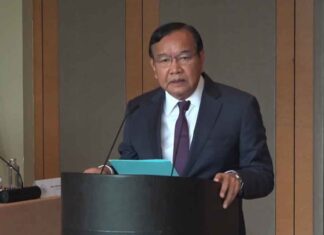
[Speech] For Cambodia, a small country with limited resources, a conscription system is an appropriate option to strengthen and increase both the full-time (full-time/professional) army and the creation of a reserve army to ensure that the government can quickly and adequately mobilize military forces to serve necessary and urgent needs.
(1) This is based on national experience and recent challenges.
[2]
[Speech] The world has reached a new paradigm shift and is seeking a new order due to the increase in border disputes, trade conflicts, and economic competition, as well as the increasingly acute technological competition such as the use of drones, artificial intelligence (AI), and cyber weapons, which are both pressures and challenges, as well as disciplines and opportunities. Cambodia, no different from countries around the world, must strengthen its capacity to turn these problems into opportunities, especially in maintaining peace, protecting national sovereignty, territorial integrity, and our beloved homeland in the process of navigating this new paradigm shift and new order with resilience and success.
(2) We cannot beg for “peace” from others. The experience of the past year has shown us that no one can help us completely and all the time, except for us to be strong ourselves. Cambodia must strive to be there. The implementation of the military conscription law is an important part. Nowadays, many countries have used the word and theory of “peace through strength.” This is a new turning point that (whether) we like this word or not, Cambodia must recognize that the theory is true and we must evolve ourselves. I would like to emphasize once again that we cannot ask for help in our pursuit of peace and the maintenance of peace from anyone, except for us to help ourselves.
[3]
[Speech] Benefits for the national economy and society – obtaining young people who are good citizens and energetic driving forces; obtaining young people who are community-minded and love social work; and obtaining young people who have the mindset of “serving the nation first.”
(3)
At this point, I would like to state that in the past, there have been many questions raised, including through His Excellency Tea Seiha, Chairman of the Committee, about the benefits (of the Military Conscription Law). Firstly, what would be the benefits to those who perform the duty? Secondly, what are the impacts of performing the duty (by citing) many reasons, such as affecting education and work. This is a concern. Thirdly, there is (this consideration) to ensure transparency and fairness in the selection process (to address) a concern that the children of the rich would not be conscribed, and only the children of the poor would. Why are many benefits and procedures not (written) in the law and (they are) only written in the sub-decree?
Firstly, I would like to emphasize that this law is a guideline. It only specifies a few principal guidelines. In order to be flexible, we listed actual implementation tasks in sub-decree. For example, the benefits to be received must be flexible according to the situation. We would like to make sure that if any year there would be other benefits to add to, we could do that (without having to) seek approval of the National Assembly. We leave it up to the organization. The same is for the selection procedure. How we do it, how we put it, and to what extent we apply it, is left in the procedures of the sub-decree and the ministry’s proclamations to ensure flexibility and efficiency.
What is necessary as a main goal is to consider the interests of individuals and families, because individuals are the key to the nation. So, implementing this mandatory law is an opportunity for the Royal Government and our nation to take a part of the youth to train them in both discipline, order, skills, and abilities in the army. Of course, serving in the army for a while would not be a uselessness or a waste of time. On the contrary, it is an effort to strengthen this part of human resources within the 24 months of training, to have responsibility, discipline, order, and patriotism. This is the key that will make a difference.
Secondly, (it is about) the impact. In preparing this law, the working group had discussed (every topic) in detail. There were suggestions about the impacts (of the Military Conscription Law) should be observed. For example, should there be an exemption for monks? There were even suggestions that widowers with many children in his burden should be exempted. We can’t do that. The important thing is that there are only a few exemptions […] In general, we try to prepare this law at a level that is flexible. For example, we would allow the exemption to be applied once a year, for a few years, in consideration of learning or some important people, related to necessary situations.
The Royal Government and the Ministry of National Defense have been thoughtful to reduce the impact and increase the benefits because a soldier (whether conscripted or not) is a resource of Cambodia. The national defense (sector) is strong only when human resources are strong, and these human resources, when completed (military service), become human resources of society who come out to fulfill their duties in state, private or personal institutions.
Of course, I can’t guarantee that all 100 people will agree. (If) 100 people accept the conditions, it means that there are only a few exceptions and understandings. Other than that, everything is obligatory. The word “obligation” is to be implemented in the law. Well, some people may have many reasons, many comparisons. While discussing (the military conscription law), we came to the idea that if those reasons are taken as basis, we cannot implement this law at all (because) 100 people might have 100 reasons/problems.
I see, however, a lack of important questions. In asking what have we gained, and what we may lose, (there have been) concerns about livelihood, time, and work. I have not seen on social media, any question that asks what should be done to instill a high patriotic mindset in citizens, especially young people who are willing to sacrifice everything and at all time, without conditions for the nation. This is the question that needs to be asked.
If we can cultivate this willpower, the concerning issue of losing the two-year time (in military conscription) or lack of this or that is no longer a (challenge). Judging by the questions asked, there seems to be a thought that (military) service is a burden. (We) need to change this mindset. Military service is a great honor that everyone should want to do. This is what the National Assembly’s leaders and deputies should bring to the people and answer the people’s questions. Of course, we would not be able to eliminate 100% issues about what benefits are to be obtained, and reducing the impact immediately. The important thing hare is to cultivate human resources, the will, not only for young people, but also the whole family to see the law of military service, and serving the nation by fulfilling military service, is a great honor for individuals and families. We must together inspire this key spirit.
If you can’t afford to spend two years (in the military service), how could you expect to be called to sacrifice your life to defend the territory? This is a matter. If, in going (to fulfill your duty,) you are afraid of being fired (from work), losing your salary (etc.), how could you sacrifice? (Please) ask the thousands and tens of thousands of young people who are currently stationed at the border to defend the territory. What are they? Those brave soldiers national police, and military police – who are stationed at the border – are all the same young people, with the same family problems, but they dare to sacrifice not for the sake of the salary. If (they think only) for the salary, they would not dare to sacrifice their lives and wouldn’t have gone. They could just come to work in Phnom Penh or go somewhere else. But as you can see, they dare to go (to defend the territory).
This is the goal of the Military Conscription Law. We want to expand human resources who have a high sense of dedication to the motherland and can fulfill their duties when the nation needs them, are willing to sacrifice everything, and, most importantly, their lives for the motherland. This is the goal of the spirit that we all need to inspire. This is the main goal of the Military Conscription Law. After two years, they will have the will, conscience, and constant readiness for the motherland.
The Honorable National Assembly,
This Cambodia has given us so much. As I said, if there are no Cambodian children to stand defending the country, there would be no foreigners to protect us, especially after the painful experience of this year, during the war of aggression. We must all remember that “Cambodia must strengthen itself,” and all Cambodian children, especially young people, who have the necessary qualifications, must be prepared to participate.
I am grateful to have witnessed the patriotic spirit of our people during the two recent armed conflicts. We have seen that both young and old, both abroad and at home, civil servants, those in the private sector, and even beggars, have joined in to support our troops who are fighting to defend the nation. However, we do not want this spirit to be just a spark. We want this spirit to be fully prepared to become an ongoing activity.
Therefore, I seek the attention of the honorable National Assembly, especially His Excellencies the leaders and deputies, who are going to meet with the people, help promote the development of the mindset, inspire patriotism, and get ready for making sacrifices to defend the nation. Through your explanation, if they understand the value (of military service), I believe that the question of fearing that this person would and that person would not answer to the conscription, wasting two years, will not finish school, and other matters, will not be a big deal. National defense and the opportunity to participate will become a great honor, a valuable thing that all young people compete for and no longer ask the question (of expressing concern) that “only the children of the poor will do their duty and the children of the rich (will not be required to do their duty).”
We want the military conscription law and the military service to become something that is desired. Without will, we will not strengthen our strength. (We can) modernize weapons and equipment. We can buy them. We can spend on training. But without real will, when a war breaks out, when the nation is in needs, (we will face challenges that we have) no one (to stand to it), or at least no one will dare to sacrifice. I would like to quote a phrase from former US President John F. Kennedy, who often spoke to emphasize the key point of the Conscription Act (and) that I remember: “Ask not what your country can do for everyone. Ask what you can do for your country.” Don’t ask questions of what to be gained from it but think about what we can do for the country. So, this Conscription Act is a means to cultivate the will of young people as well as the families of our citizens, especially joining the military with the support of the family, the entire population, all sectors, whether state or private, because the law also requires the participation of all sectors to contribute to this small nation. This is the point regarding the benefits (of the Conscription Act) that I want to emphasize […]./.